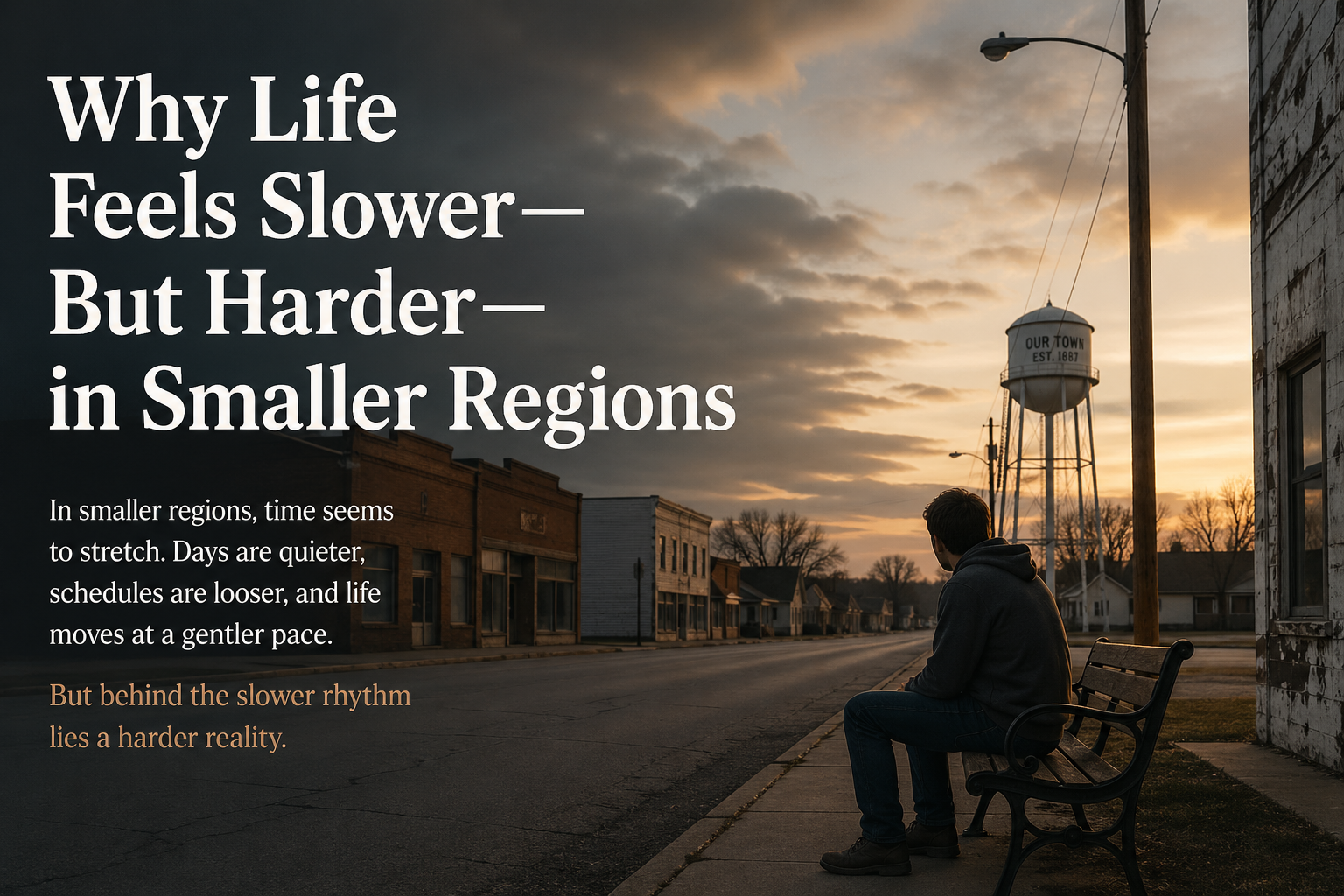
You notice it almost immediately, though it’s hard to explain at first. Things move more slowly, conversations last longer, days feel less rushed. And yet, somehow, life feels slower — but harder — in smaller regions, even when everything seems calm on the surface.
The Pace Is Slower, but the Effort Isn’t
At first, the slower rhythm feels like relief.
There’s less noise, fewer deadlines, fewer constant interruptions. You’re not being pulled in ten directions at once. Time stretches out a bit. Mornings don’t feel like a race.
But then something else becomes clear.
Simple things take more effort.
Getting something fixed, finding a specific service, solving a small problem — none of it is impossible, but it rarely happens quickly. You wait. You adjust. You figure things out on your own more often than you expected.
The pace is slower, yes. But the effort behind everyday tasks quietly increases.
Fewer Options Means More Responsibility
In bigger places, you don’t always notice how much is already handled for you.
Choice is everywhere. If one thing doesn’t work, there’s usually another option nearby. That creates a sense of flexibility, even if you don’t consciously think about it.
In smaller regions, that flexibility shrinks.
Not dramatically. Just enough to change how decisions feel.
When options are limited, every choice carries more weight. You don’t just pick what you prefer — you often pick what’s available. And if something doesn’t work out, switching isn’t always simple.
So people adapt.
They become more resourceful. More patient. Sometimes more cautious.
But that adaptation comes with a cost: more mental load behind decisions that used to feel easy.
Everyday Life Becomes More Personal
There’s another layer that doesn’t show up in obvious ways.
In smaller places, systems are less anonymous. People know each other, or at least recognize each other. Interactions repeat. Relationships overlap.
That can be comforting.
It can also make things more complicated.
A simple situation — a disagreement, a delay, a misunderstanding — doesn’t always stay contained. It lingers, because you’re likely to run into the same people again. You can’t always step away and reset.
So even small issues feel heavier.
Not because they’re objectively bigger, but because they stay closer to you.
Time Feels Abundant, but Progress Feels Slower
One of the strangest contrasts appears over time.
You have more time — or at least it feels that way. Fewer distractions, fewer external pressures pushing you forward.
But progress doesn’t always match that feeling.
Plans take longer to unfold. Changes happen gradually, sometimes so gradually you barely notice them. What might take months elsewhere can stretch into years.
And that creates a quiet tension.
You’re not rushing, but you’re also not moving as quickly as you thought you would. There’s space to think, but fewer triggers to act.
It’s not stagnation. It’s just… slower momentum.
The Hidden Trade-Off
People often talk about slower life as something purely positive. And in many ways, it is.
But there’s a trade-off that becomes clearer with time.
You gain calm. You lose speed.
You gain space. You lose convenience.
And somewhere in between, life feels slower — but harder — in smaller regions in ways that don’t show up in simple comparisons.
It’s not about better or worse.
It’s about how the same day, the same task, the same decision can carry a different weight depending on where you are — even if, on the surface, everything seems easier.